Dental Bridge in Dubai: Types, Cost Factors & What to Expect
Understand dental bridge types, cost factors and what to expect from treatment.
Introduction
Missing a tooth can affect more than the appearance of your smile. Depending on its location, a missing tooth may also affect chewing, speech, your bite, and the way neighbouring teeth function.
One treatment that may be considered for replacing one or more missing teeth is a dental bridge.
A dental bridge uses one or more replacement teeth to fill a gap in the mouth. Depending on the type of bridge, it may be supported by natural teeth, dental crowns, or dental implants.
But not every bridge is the same—and not every patient with a missing tooth needs one.
If you are considering a dental bridge in Dubai, understanding the available types, cost factors, treatment process and alternatives can help you have a more informed discussion with your dentist.
Your guide to dental bridges.
What Is a Dental Bridge?
A dental bridge is a fixed dental restoration used to replace one or more missing teeth.
As the name suggests, the restoration effectively "bridges" the space created by a missing tooth.
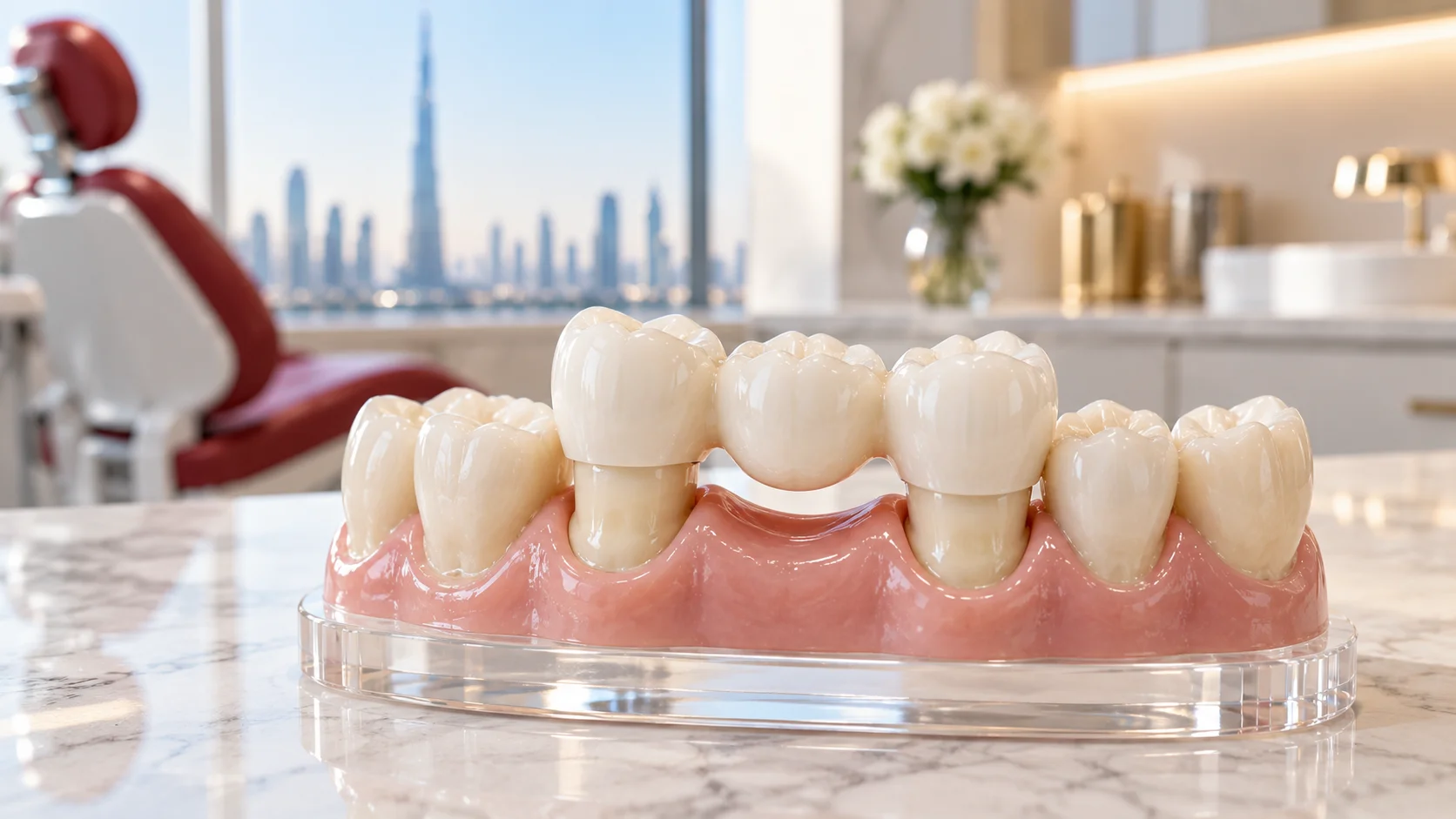
The artificial replacement tooth in a bridge is commonly referred to as a pontic. Depending on the type of bridge, the pontic is supported by neighbouring teeth, crowns, or dental implants.
Unlike a removable denture, a conventional fixed dental bridge is secured in the mouth and is not normally removed by the patient for daily cleaning.
Dental bridges may be considered to:
Replace missing teeth
Restore chewing function
Improve the appearance of a gap
Support appropriate bite function
Help maintain the relationship between surrounding teeth
Whether a bridge is appropriate depends on the condition of the neighbouring teeth, gums, bone, bite and overall oral health.
What Are the Different Types of Dental Bridges?
There are several types of dental bridges.
The appropriate design depends on the number and location of missing teeth, the condition of neighbouring teeth and the amount of support available.
1. Traditional Dental Bridge
A traditional fixed bridge is one of the commonly used designs.
It typically involves placing crowns on teeth adjacent to the missing tooth or teeth. These crowns support the replacement tooth positioned between them.
For example:
Supporting tooth → Replacement tooth → Supporting tooth
A traditional bridge may be considered when suitable natural teeth are available on both sides of the gap.
Because the supporting teeth generally need to be prepared for crowns, the condition of those teeth is an important consideration.
2. Cantilever Dental Bridge
A cantilever bridge is supported primarily from one side of the missing-tooth space.
This design may be considered in selected situations where support is available on only one side.
However, because forces are distributed differently compared with a conventional bridge, a cantilever design is not suitable for every location or bite.
Your dentist needs to assess the forces placed on the bridge before recommending this option.
3. Maryland Bridge
A Maryland bridge, sometimes called a resin-bonded bridge, uses a different method of support.
Instead of placing full crowns on neighbouring teeth, the replacement tooth is typically supported by a framework or wings bonded to the back of adjacent teeth.
This approach can preserve more natural tooth structure in selected cases.
However, Maryland bridges are not appropriate for every missing tooth or every bite.
The dentist needs to consider:
Tooth location
Bite forces
Condition of neighbouring teeth
Available enamel for bonding
Size of the missing-tooth space
4. Implant-Supported Dental Bridge
An implant-supported bridge is supported by dental implants rather than relying entirely on natural neighbouring teeth.
This may be considered when several adjacent teeth are missing.
The implants act as supporting structures for the bridge.
Because implant treatment involves the jawbone and supporting tissues, additional assessment is required. This may include dental imaging and evaluation of:
Bone quantity
Bone quality
Gum health
Medical history
Implant position
Bite
Implant-supported bridges therefore involve a different treatment pathway from conventional tooth-supported bridges.
What Materials Are Used for Dental Bridges?
Dental bridges can be made from different restorative materials.
The appropriate material depends on factors such as:
Tooth location
Number of teeth being replaced
Bite forces
Aesthetic requirements
Bridge design
Available space
Dentist and laboratory recommendations
Common options may include zirconia, other dental ceramics, porcelain-fused-to-metal (PFM), and other restorative materials depending on the clinical situation.
Zirconia Dental Bridge
Zirconia is a ceramic material used for crowns and bridges.
Potential considerations include:
Tooth-coloured appearance
High mechanical strength
Metal-free construction
Availability in different formulations
Use in selected anterior and posterior restorations
However, zirconia is not automatically the right material for every bridge.
The length of the bridge, location in the mouth, bite and aesthetic requirements all need to be considered.
PFM Dental Bridge
A porcelain-fused-to-metal bridge, or PFM bridge, combines a metal framework with a tooth-coloured porcelain exterior.
PFM restorations have been used in restorative dentistry for many years.
Potential considerations include:
Metal framework for structural support
Tooth-coloured porcelain exterior
Use in different areas of the mouth
Different aesthetic characteristics compared with metal-free ceramics
Your dentist can explain which material is appropriate based on your individual treatment requirements.
Who May Need a Dental Bridge?
A dental bridge may be considered when one or more teeth are missing and there is appropriate support for a fixed restoration.
Possible situations include:
A Single Missing Tooth
A bridge may be used to replace one missing tooth when the surrounding teeth can appropriately support the restoration.
Multiple Adjacent Missing Teeth
Certain bridge designs can replace more than one missing tooth.
However, as the span becomes longer, the forces placed on the supporting teeth or implants need careful consideration.
Teeth Lost Due to Decay
If a tooth cannot be predictably restored because of extensive decay and needs to be extracted, a bridge may be one of the replacement options discussed after healing and assessment.
Teeth Lost Due to Trauma
A missing tooth caused by trauma may sometimes be replaced with a bridge depending on the condition of the surrounding teeth and supporting structures.
Teeth Lost Due to Gum Disease
If tooth loss is associated with periodontal disease, the health and stability of the remaining teeth and gums must be carefully assessed before planning a bridge.
When Might a Dental Bridge Not Be Suitable?
A bridge is not necessarily appropriate for every missing tooth.
Alternative treatment may be considered if there is:
Active gum disease
Untreated tooth decay
Insufficient support from neighbouring teeth
Significant bone or gum problems
Unfavourable bite forces
Severe teeth grinding or clenching
Poor oral hygiene
Extensive structural problems affecting supporting teeth
In some situations, a dental implant or removable denture may be more appropriate.
The decision should be made after a clinical examination rather than based solely on cost or convenience.
How Much Does a Dental Bridge Cost in Dubai?
There is no single dental bridge cost in Dubai because treatment can vary considerably between patients.
A bridge replacing one tooth with two supporting crowns is different from a longer bridge involving several units.
The final cost may depend on:
Number of units in the bridge
Material used
Number of missing teeth
Condition of supporting teeth
Need for additional dental treatment
Bridge design
Laboratory requirements
Complexity of the case
For this reason, dental bridges are commonly discussed in terms of the number of units involved.
What Does "Per Unit" Mean for a Dental Bridge?
Understanding this term is particularly important when comparing dental bridge prices.
A bridge may consist of multiple connected units.
For example, if one missing tooth is replaced using a traditional three-unit bridge:
Crown + Replacement Tooth + Crown = 3 units
This means the restoration contains:
One crown on the supporting tooth on one side
One artificial tooth replacing the missing tooth
One crown on the supporting tooth on the other side
So when a clinic quotes a dental bridge on a per-unit basis, you need to know the total number of units required before estimating the complete treatment cost.
Your dentist can determine this after examining the missing-tooth space and supporting teeth.
What Factors Affect Dental Bridge Cost in Dubai?
1. Number of Missing Teeth
The number of teeth that need replacement can directly affect the size and complexity of the bridge.
A single missing tooth may require a different bridge design from several adjacent missing teeth.
2. Number of Bridge Units
More units generally mean a larger restoration and additional laboratory work.
The dentist must also ensure that the supporting teeth or implants can adequately support the planned restoration.
3. Bridge Material
The material selected can affect the treatment cost.
For example, zirconia and PFM bridges use different materials and fabrication techniques.
The appropriate choice should be based on clinical requirements as well as aesthetics and cost.
4. Condition of the Supporting Teeth
Before placing a conventional bridge, the dentist needs to examine the teeth that will support it.
If a supporting tooth has:
Decay
A large existing filling
Pulpal problems
Gum disease
Structural damage
additional treatment may be required before the bridge can be placed.
5. Need for Root Canal Treatment
Not every supporting tooth needs root canal treatment.
However, if a tooth has an existing pulpal or structural problem, root canal treatment may sometimes be necessary as part of the overall treatment plan.
This would affect the total treatment cost.
6. Implant Support
An implant-supported bridge involves a different treatment process and additional components compared with a conventional tooth-supported bridge.
Implant surgery, implant components, imaging and the final restoration all need to be considered in the treatment plan.
What Happens During a Dental Bridge Procedure?
The procedure depends on the type of bridge selected.
For a conventional tooth-supported bridge, treatment may involve the following steps.
Step 1: Dental Examination
Your dentist examines:
Missing-tooth area
Supporting teeth
Gums
Bite
Existing restorations
Overall oral health
Dental X-rays or other imaging may be recommended when clinically appropriate.
Step 2: Treatment Planning
Your dentist discusses the available tooth-replacement options.
This may include:
Dental bridge
Dental implant
Removable denture
Other appropriate treatment
If a bridge is selected, the dentist determines the design, number of units and suitable material.
Step 3: Preparing the Supporting Teeth
For a traditional bridge, the supporting teeth are generally prepared so that crowns can fit over them.
This involves removing some tooth structure to create space for the restoration.
Because this process alters the supporting teeth, their condition should be carefully assessed before treatment.
Step 4: Impression or Digital Scan
An impression or digital scan records the prepared teeth and surrounding structures.
This information is used to fabricate the bridge.
The dental laboratory or restorative workflow needs to reproduce:
Tooth shape
Contacts
Bite
Missing-tooth space
Appropriate contours
Step 5: Temporary Bridge
A temporary restoration may be used while the final bridge is being fabricated.
Your dentist will advise you on caring for the temporary bridge and what foods to avoid.
Step 6: Fitting the Final Bridge
Once the final bridge is ready, the dentist evaluates:
Fit
Bite
Contact points
Shape
Colour
Gum relationship
Overall appearance
Adjustments may be made if necessary.
Step 7: Cementation
When the dentist is satisfied with the restoration, the bridge is secured using an appropriate dental cement or bonding protocol.
The dentist will then provide instructions on cleaning and maintaining the bridge.
Does Getting a Dental Bridge Hurt?
Local anaesthesia is generally used when natural teeth need to be prepared.
This helps manage discomfort during the procedure.
Some patients may experience temporary sensitivity or mild discomfort following tooth preparation or bridge placement.
However, severe or persistent pain should be assessed by your dentist.
Contact the clinic if you experience:
Increasing pain
Swelling
Persistent sensitivity
Difficulty biting
A bridge that feels loose
A bite that feels significantly uneven
How Long Does It Take to Get a Dental Bridge?
Treatment time depends on the type of bridge and complexity of the case.
A conventional bridge may require multiple stages because the teeth need to be prepared and the final restoration fabricated.
Additional treatment can extend the overall timeline.
For example, treatment may take longer if you require:
Tooth extraction
Gum treatment
Root canal treatment
Implant placement
Bone healing
Additional restorative treatment
Your dentist can provide a more accurate treatment timeline after completing the examination.
How Long Does a Dental Bridge Last?
There is no guaranteed lifespan for a dental bridge.
Longevity can depend on:
Oral hygiene
Health of supporting teeth
Gum health
Bridge design
Restorative material
Bite forces
Teeth grinding or clenching
Diet
Regular dental care
Importantly, the artificial replacement tooth itself cannot develop tooth decay—but the natural supporting teeth can.
Decay around a supporting tooth can compromise the entire bridge.
This makes daily cleaning and regular dental examinations particularly important.
How Do You Clean Under a Dental Bridge?
Cleaning underneath a bridge is one of the most important parts of long-term maintenance.
Because the replacement tooth is connected to the supporting crowns, ordinary floss may not pass vertically between the connected units.
Your dentist or dental hygienist may recommend:
Floss threaders
Super floss
Interdental brushes
Other bridge-cleaning aids
A water flosser as an additional cleaning method in appropriate cases
The exact technique depends on the bridge design.
The goal is to remove plaque and food debris around the supporting teeth and underneath the replacement tooth.
Can You Eat Normally With a Dental Bridge?
After the bridge has been fitted and the dentist confirms that your bite is appropriate, you should receive instructions on eating and maintaining the restoration.
It is generally sensible to avoid using dental restorations to bite extremely hard objects.
If you grind or clench your teeth, discuss this with your dentist because excessive forces can affect natural teeth and restorations.
A protective night guard may be considered in appropriate cases.
Dental Bridge vs Dental Implant: Which Should You Choose?
Both treatments can replace missing teeth, but they work differently.
| Factor | Dental Bridge | Dental Implant |
|---|---|---|
| Main purpose | Replaces missing tooth/teeth | Replaces missing tooth root and supports restoration |
| Support | Natural teeth or implants, depending on bridge type | Jawbone |
| Adjacent teeth | Conventional bridge may require preparation | Adjacent teeth usually do not need preparation solely to support the implant |
| Surgery | Conventional bridge usually does not require implant surgery | Implant placement involves a surgical procedure |
| Treatment time | Depends on bridge and supporting teeth | May involve healing periods |
| Bone requirements | Depends on bridge type | Adequate bone support is important |
| Cleaning | Requires cleaning around and underneath bridge | Requires cleaning around implant restoration |
| Suitability | Depends on supporting teeth and bite | Depends on bone, gums, health and other factors |
Neither option is automatically better.
For example, if neighbouring teeth already require crowns, a bridge may be considered differently than if the adjacent teeth are completely intact.
Conversely, an implant may allow replacement of a missing tooth without preparing neighbouring teeth, but implant treatment requires its own clinical assessment and surgical considerations.
Your dentist can discuss the advantages and limitations of each option for your specific case.
Dental Bridge vs Denture: What's the Difference?
A conventional dental bridge is a fixed restoration, while a traditional removable denture can be taken out by the patient.
Dental Bridge
Fixed in the mouth
Supported by teeth or implants
Replaces one or more missing teeth
Requires suitable support
Requires specific cleaning around the bridge
Removable Denture
Removable by the patient
Can replace multiple teeth
May be considered when several teeth are missing
Uses a different support and retention system
Requires removal and cleaning according to dental instructions
The appropriate treatment depends on the number and position of missing teeth, oral health, available support and patient preferences.
What Happens If You Don't Replace a Missing Tooth?
Not every missing tooth automatically requires the same treatment, but leaving a space can sometimes affect the surrounding dentition.
Depending on the location and individual case, possible changes can include:
Movement of neighbouring teeth
Changes in bite
Difficulty chewing in that area
Food trapping
Aesthetic concerns
Changes in opposing tooth position
The consequences vary significantly between patients.
A dentist can assess whether replacing the missing tooth is advisable and which treatment options are appropriate.
When Should You Book a Dental Bridge Consultation?
Consider arranging an assessment if:
You have recently lost a tooth
You have had a tooth extracted
You have an old bridge that feels loose
Your existing bridge is damaged
Food repeatedly collects underneath a bridge
You experience pain around a supporting tooth
You are comparing bridges, implants and dentures
You want to replace one or more missing teeth
If you have active pain, swelling or infection, seek dental assessment rather than waiting solely for a cosmetic tooth-replacement consultation.
Frequently Asked Questions About Dental Bridges in Dubai
The cost depends on the number of units, material, bridge design, supporting teeth and whether additional treatment is required. An examination is needed to determine the complete treatment plan.
Why Choose WhiteLine Dental Clinic for Dental Bridges in Dubai?
At WhiteLine Dental Clinic in Al Rigga, Deira, Dubai, dental bridges are provided as part of the clinic's restorative dental services.
Treatment starts with assessing the missing-tooth area and the condition of the surrounding teeth, gums and bite.
Depending on your needs, treatment options available at WhiteLine include:
Dental bridges
Dental crowns
Dental implants
Dentures
Dental fillings
Root canal treatment
Tooth extraction
Teeth cleaning
Dental veneers
Teeth whitening
Braces
Invisalign
For patients with missing teeth, the goal of the consultation is not simply to choose between a bridge and an implant.
The dentist first determines what can appropriately support the replacement tooth and which treatment is suitable for your oral condition.
Final Thoughts: Is a Dental Bridge Right for You?
A dental bridge can be an option for replacing one or more missing teeth, but the right design depends on your individual dental condition.
Your dentist will need to consider:
Number of missing teeth
Condition of neighbouring teeth
Gum health
Available support
Bite forces
Bridge material
Aesthetic requirements
Oral hygiene
Alternative treatments such as implants or dentures
Cost is an important consideration, but it should not be the only factor when deciding how to replace a missing tooth. Understanding the number of bridge units, material being used, condition of the supporting teeth and any additional treatment required will give you a much clearer picture of the total treatment.
Book a Dental Bridge Consultation in Al Rigga, Dubai
If you have one or more missing teeth, visit WhiteLine Dental Clinic, Al Rigga, Deira, Dubai for an assessment of your tooth-replacement options.
Book a consultation to discuss whether a dental bridge, dental implant, denture or another treatment option is appropriate for you.
More from the journal.

Tooth Filling Cost in Dubai: What Affects the Price?
Zirconia Crowns in Dubai: Benefits, Uses & How They Compare With Other Crowns